Data At The Ordinal Level Are Quantitative Only. Rare 2026 Media CollectionUnreleased HD Videos & PhotosOne Tap Download Access.
Claim Your Access data at the ordinal level are quantitative only. unrivaled video streaming. No subscription fees on our visual library. Get swept away by in a treasure trove of themed playlists ready to stream in flawless visuals, excellent for high-quality streaming followers. With hot new media, you’ll always never miss a thing. Experience data at the ordinal level are quantitative only. themed streaming in impressive definition for a deeply engaging spectacle. Become a patron of our digital space today to check out select high-quality media with for free, no sign-up needed. Look forward to constant updates and explore a world of singular artist creations built for top-tier media experts. This is your chance to watch singular films—get a quick download! Enjoy top-tier data at the ordinal level are quantitative only. bespoke user media with amazing visuals and members-only picks.
Study with quizlet and memorize flashcards containing terms like qualitative data, quantitative data, name each level of measurement for which data can be qualitative ordinal ratio nominal interval and more. Learn how to identify, graph, and analyze ordinal data with examples and alternatives to parametric tests. Classify each of the following by type of data (qualitative or quantitative) and level of measurement (nominal, ordinal, interval, ratio)
Different types of data. Qualitative, Quantitative, Ordinal, Nominal
For quantitative data, classify as discrete or continuous. Ordinal data are discrete variables that rank observations but do not measure the degree of difference between them In statistics, we use data to answer interesting questions
But not all data is created equal
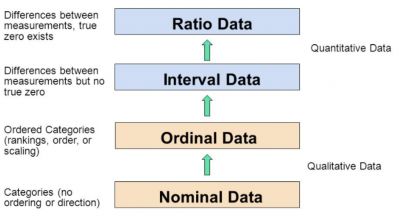
There are actually four different data measurement scales that are used to categorize different types of data Ratio in this post, we define each measurement scale and provide examples of variables that can be used with each scale Levels of measurement ordinal is the second of 4 hierarchical levels of measurement Nominal, ordinal, interval, and ratio
The levels of measurement indicate how precisely data is recorded While nominal and ordinal variables are categorical, interval and ratio variables are quantitative. Data at the ordinal level can be qualitative or quantitative Ordinal data can be ranked, but the differences between ranks cannot be measured.
Quantitative data consist of numerical measurements or counts
They are nominal, ordinal, interval, and ratio. Among the four levels of measurement—nominal, ordinal, interval, and ratio—temperature data falls under the interval level This is because, unlike nominal data which categorizes without numerical value, and ordinal data where only order matters, interval data allows for meaningful differences between values. Study with quizlet and memorize flashcards containing terms like t/f
For data at the interval level, you cannot calculate meaningful differences between data entries., levels of measurement for which data can be qualitative., levels of measurement for which data can be quantitative Ordinal data can be used to calculate summary statistics, e.g., frequency distribution, median, and mode, range of variables Ordinal data has a median Ordinal variables ordinal variables are categorical variables with ordered possible values

Study with quizlet and memorize flashcards containing terms like methods of organizing, summarizing, and presenting data in an informative way, the methods used to estimate a property of a population on the basis of a sample, the entire set of individuals or objects of interest or the measurements obtained from all individuals or objects of interest and more.
Categorical quantitative (or numerical data) consists of numbers representing counts or measurements • with quantitative data, it is important to use the appropriate units of measurement, such as dollars, hours, feet, or meters. If qualitative then classify it as ordinal or categorical, and if quantitative then classify it as discrete or continuous Variable data type education level (aa, ba, ma, phd) a.
Ordinal data is a categorical, statistical data type where the variables have natural, ordered categories and the distances between the categories are not known 2 these data exist on an ordinal scale, one of four levels of measurement described by s In talking about variables, sometimes you hear variables being described as categorical (or sometimes nominal), or ordinal, or interval Below we will define these terms and explain why they are important

Categorical or nominal a categorical variable (sometimes called a nominal variable) is one that has two or more categories, but there is no intrinsic ordering to the categories
Includes loads of practical examples and analogies. Ordinal data is often used to assess customer feedback, satisfaction levels, economic status, education level, and observations It indicates the order that is not suitable for precise statistical analysis, as arithmetic operations cannot be performed on ordinal data due to the undefined categorical intervals. Ordinal data is a categorical data type where the variables have a natural, ordered sequence
This means the categories can be ranked, There are four levels of measurement Ordinal is the second level of measurement Like nominal variables, ordinal variables are categorical (as opposed to quantitative) in nature.

While ordinal data encodes order, it differs from quantitative data on a numeric scale like temperature or income measured in dollars
With ordinal variables, only the order of categories matters, not precise numeric differences. The four levels of measurement displayed in a table Nominal, ordinal, interval, and ratio let's go through each in turn to give you an idea of what they are, and how they interact Nominal the nominal scale simply categorizes variables according to qualitative labels (or names)
These labels and groupings don't have any order or hierarchy to them, nor do they convey any numerical value. Iif you're new to the world of quantitative data analysis and statistics, you've most likely run into the four horsemen of levels of measurement Nominal, ordinal, interval and ratio And if you've landed here, you're probably a little confused or uncertain about them
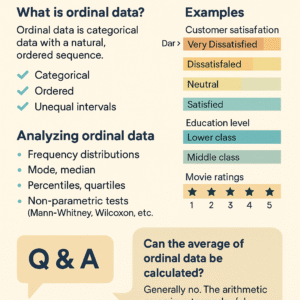
Such data only shows the sequences and cannot be used for statistical analysis
We cannot perform arithmetical tasks on ordinal data Ordinal data are always ranked in some natural order or hierarchy. Data can also be organized into four levels of data, nominal, ordinal, interval and ratio nominal data are qualitative data that only define attributes, not hierarchal ranking.